
SME Financing in Latvia: Key Insights from an Industry Seminar
Introduction
On March 3, 2026, a seminar on small and medium enterprise financing in Latvia took place in Riga, attended by financial sector representatives, banks, and entrepreneurs.
Several studies and data on financing availability in Latvia were presented at the event. Experts from SEB Bank, Citadele, the Financial Industry Association, and the Credit Information Bureau (KIB) participated in the discussion. In total, approximately 50 entrepreneurs and financial sector representatives attended the seminar.
During the seminar, an analysis was conducted on how business financing is developing in Latvia, how banks make lending decisions, and why some businesses still face difficulties in attracting capital.
Below, we have compiled the most important insights for entrepreneurs to help better understand the financing reality in Latvia.
Key Insights
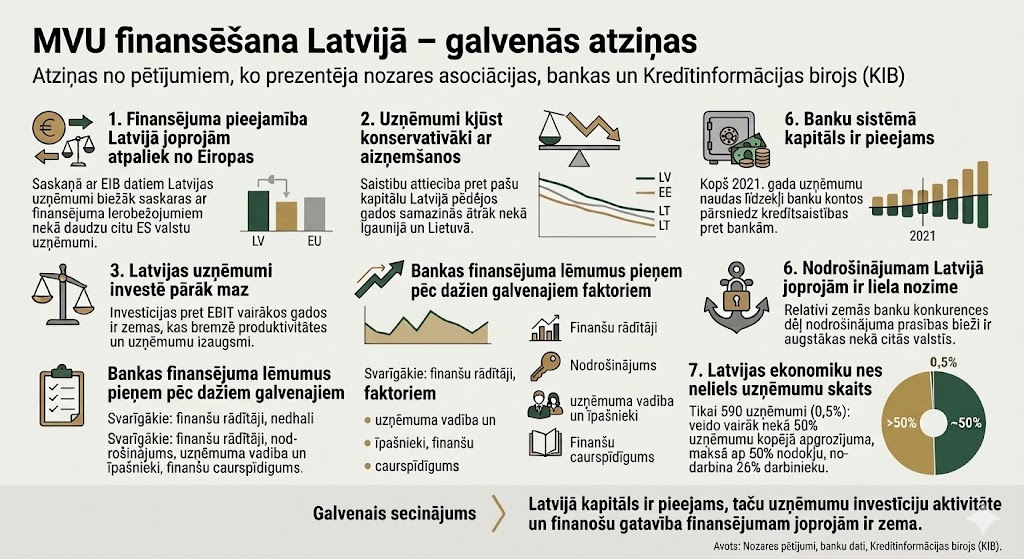
1. Latvia Still Lags Behind Europe in Financing Availability
According to European Investment Bank (EIB) data, Latvian businesses face financing constraints more frequently than companies in many other European Union countries.
This means that businesses in Latvia often experience:
- greater difficulty in attracting capital
- more complex credit terms
- higher collateral requirements
At the same time, Latvia's financial sector is stable, and capital is available in the banking system. This creates an interesting paradox – capital exists, but is not always fully utilized for business development.
2. Latvian Companies Are Becoming More Conservative with Borrowing
Data presented at the seminar revealed an interesting trend.
In Latvia, the debt-to-equity ratio has been declining in recent years, and this is happening faster than in Estonia or Lithuania.
This means that companies are:
- borrowing less
- relying more on equity capital
On one hand, this reduces financial risk. On the other hand, it may slow business growth, as capital is not being used for development.
3. Companies in Latvia Invest Relatively Little
The investment level in Latvian companies is one of the factors affecting economic growth.
Data presented at the seminar shows that investments relative to EBIT are relatively low in some years.
When companies invest little in:
- technology
- production efficiency
- digitalization
- new markets
productivity growth is slower.
In the long term, this affects both corporate competitiveness and overall economic development.
4. Capital Is Available in the Banking System
An interesting fact from seminar discussions – in recent years, Latvian companies' cash holdings in bank accounts exceed their credit obligations to banks.
This means that some companies choose to:
- finance development from their own funds
- be more conservative with credit usage
However, in many cases, external capital can be an important development tool for company growth.
5. Banks Make Financing Decisions Based on Several Key Factors
The seminar also discussed how banks evaluate business financing applications.
Decisions are typically based on four key factors:
- company financial metrics
- collateral
- owner and management experience
- financial transparency
Banks assess a company's ability to consistently generate cash flow that allows servicing credit obligations.
6. Collateral Remains an Important Factor in Latvia
Although theoretically the quality of a company's business is also important in lending decisions, in practice collateral still plays a significant role in Latvia.
This is partly related to:
- relatively low competition among banks
- conservative risk management policies
- financial market structure
As a result, companies often need real estate or other collateral to obtain financing.
7. A Small Number of Companies Drive Latvia's Economy
One of the most interesting data points from the seminar concerned the structure of companies in Latvia.
Only 590 companies (0.5% of all companies):
- generate more than 50% of corporate turnover
- pay approximately 50% of taxes
- employ 26% of workers
This means that Latvia's economic structure is highly concentrated.
The majority of companies are small and often face challenges in attracting financing and funding growth.
Key Conclusion
The seminar discussions showed that the issue of business financing in Latvia is not just about banks or credit availability.
It is also about:
- corporate financial structure
- investment culture
- companies' readiness to use capital for growth
Capital is available in Latvia's financial system, but many companies still use it cautiously or insufficiently.
For companies seeking faster development, it is important not only to earn but also to strategically use capital for business growth.
Interested in financing for your business?
Oferta Finance helps entrepreneurs secure funding for growth, investment and expansion.